

Calm Begins at Home
When the world feels loud and uncertain, our nervous systems are often on alert—constantly taking in signals of threat, often without us realizing it. News cycles, global events, and social tension all live outside our control, yet they still find a way to enter our homes. Over time, the stress of the world can begin to feel inescapable.
This is where I want to gently shift the conversation.
While we can’t control the world at large, most of us have more influence than we realize over the spaces we live in. Our homes quietly shape how we feel, think, and respond every day. Our surroundings are not neutral; they are always communicating something to our nervous system.
Given the state of the world, what you choose to surround yourself with at home matters more than ever. Research in environmental psychology shows that cluttered, visually chaotic spaces increase stress and cognitive fatigue, while calm, intentional environments support emotional regulation and mental clarity. Simply put: what you live with affects how you live.
This is something I’ve been teaching (and preaching!) for over 12 years. And after spending time in France last fall, I was reminded that this is something the French seem to understand deeply as well. In France, beauty is not treated as indulgent or optional—it’s considered essential. Light, proportion, simplicity, and care for one’s surroundings are woven into daily life because they understand that beauty steadies us. It reminds us we are human.
Your home should do the same.
Below is a simple practice you can use to restore calm in your own home. It takes just a few minutes and combines breath, awareness, and attention to your physical environment.
Step 1: Pause and breathe.
Sit or stand where you are. Inhale through your nose for 4 counts.
Exhale slowly through your mouth for 6–8 counts.
Repeat this three times.
Step 2: Name what’s within your control—at home.
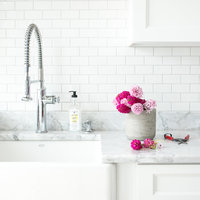
Write down three things you can influence in your space today. Keep them small and manageable. This might look like clearing one surface, putting items back where they belong, letting go of something that creates tension or guilt, or occasionally bringing in something that feels calming or beautiful (think flowers).
Step 3: Take one small, physical action.
Spend five minutes tending to a single area—one drawer, one shelf, or one corner.
Stop before it feels like work.
This practice is effective for several reasons. The breathwork helps regulate your body by activating the parasympathetic nervous system, signaling safety. Naming what you can control restores a sense of agency, which reduces stress and overwhelm. And finally, physical order supports emotional calm.
This practice is not about perfection. It’s about gently aligning your surroundings with how you want to feel. Calm is not the absence of chaos; it’s the ability to maintain a sense of steadiness when life feels unsteady. Your home should be a place that supports that feeling—quietly, consistently, and with care.